Quickair
Quickair
If your compressor seems to be running longer than it used to, or your energy bills have been creeping up without a clear reason, the culprit is very often something invisible: compressed air leaks. Compressed air leak detection isn’t just a maintenance checklist item — it’s one of the highest-ROI things a facility can do, and most plants are losing far more than they realize.
Compressed air is often called the “fourth utility” in manufacturing, right alongside electricity, water, and gas — and it’s also the most wasted one. Industry estimates, including data referenced by the U.S. Department of Energy, put typical leak losses at 20–30% of a compressor’s total output in an average plant. In poorly maintained systems, that number climbs even higher.
Here’s what makes this expensive: a leak doesn’t just waste air. It forces your compressor to run more often and harder to maintain system pressure, which directly increases electricity consumption. A handful of small leaks scattered across a distribution network can add up to thousands of dollars in wasted energy every year — money spent producing air that never reaches a single tool or machine.
Leaks aren’t always obvious on a busy shop floor. Watch for:
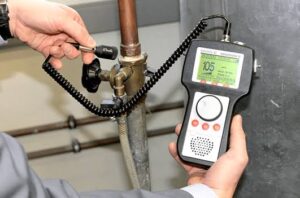
The most reliable method for compressed air leak detection is an ultrasonic acoustic detector. These handheld or camera-based devices pick up the high-frequency sound generated by escaping air — audible even over the noise of a running production floor — and pinpoint the exact leak location. This is the standard method recommended for structured leak audits.
A simpler, low-cost method: apply soapy water to suspected joints and fittings with a brush. Bubbles forming at the surface indicate escaping air. It’s reliable but slow, and impractical for auditing a large facility.
Isolating sections of your compressed air network and monitoring pressure decay over time can help identify which zones are leaking, even without pinpointing the exact spot — useful as a first step before a detailed ultrasonic survey.
Larger facilities increasingly use IoT-based sensors for ongoing compressed air leak detection, flagging abnormal air consumption patterns automatically instead of relying only on periodic manual audits.
In our experience working with piping systems across manufacturing and engineering facilities, leaks concentrate heavily at:
This is one of the practical advantages of switching to a modular aluminium piping system, covered in our guide on aluminium comressed air piping: push-fit and press-fit connections eliminate the threaded joints that are the single most common leak point in traditional steel networks.
Compressed air leak detection is one of the simplest ways to cut energy waste without touching your compressor or production process at all. A structured detection routine — combined with piping upgrades where leaks repeatedly occur — usually pays for itself within months through reduced energy costs alone.
Quickair’s modular aluminium piping systems are built with push-fit connections that eliminate the threaded joints most prone to leaks. Talk to our team about auditing or upgrading your compressed air distribution network.
Welcome Back 👋
Sign in to access your account and continue where you left off.
Welcome aboard 🚀
Create your account to access everything you need.
Links
Contact Us