Quickair
Quickair
Walk into most new industrial facilities today and you’ll notice the compressed air lines look different from what was standard a decade ago — no weld marks, no threaded unions, just clean push-fit joints running overhead. That’s a modular piping system, and it’s quickly becoming the default choice for new compressed air distribution across manufacturing, automotive, pharma, and food industries.
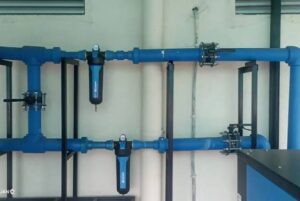
A modular piping system is built from prefabricated aluminum pipes and fittings that connect using push-fit, clamp-ring, or quick-release mechanisms — instead of welding or threading joints together on-site. Every component is manufactured to a standard specification, so pipes, elbows, tees, and valves fit together like a kit rather than requiring custom on-site fabrication.
This is the opposite of a traditional welded compressed air distribution system, where every joint is permanently fused in place and any future change means cutting into pressurized pipework.
Welding requires a certified fitter, ventilation precautions, and typically means shutting down that section of the plant while work happens. A modular piping system installs with hand tools by a general maintenance crew — commonly 3-4x faster than an equivalent welded job. For plants that can’t afford extended downtime, this alone justifies the switch.
Every welded or threaded joint is a potential leak point, and threaded connections loosen over time with vibration and thermal cycling. A modular system’s push-fit joints are pressure-tested at manufacture, which is why leak-free piping is one of the most consistently cited reasons plants make the switch. Leaks aren’t just a maintenance nuisance — they’re wasted compressor output, which shows up directly on your energy bill.
Because a modular system stays leak-free far longer than welded pipework, your compressor doesn’t have to work harder to compensate for lost air. Combined with aluminum’s smooth internal bore (which reduces friction and pressure drop compared to corroded steel), a well-designed modular aluminum piping system is meaningfully more energy efficient over its service life — often the single biggest lever for cutting compressed air operating costs.
Production lines move. Machines get added, relocated, or removed. With a welded system, any layout change means cutting out sections and re-welding — expensive, slow, and disruptive. A modular piping system can usually be unclipped, extended, or rerouted in the affected section only, without depressurizing or rebuilding the entire line.
Welding compressed air pipework requires a certified welder. Installing or modifying a modular system typically doesn’t — which matters for plants without in-house welding capability, or ones spread across multiple sites where bringing in specialized labor for every small change isn’t practical.
A complete modular piping system typically includes:
For guidance on getting the diameter right for your plant’s demand, see our compressed air pipe sizing guide.
Modular is generally the better choice if:
A welded steel system may still make sense for very high-temperature applications outside standard aluminum ratings — see our aluminium vs steel compressed air pipe comparison for a full breakdown. According to the U.S. Department of Energy’s compressed air systems guidance, leak reduction and proper system design are among the most effective ways to cut compressed air energy costs — both are core strengths of a well-installed modular piping system.
A modular piping system solves the three biggest pain points of traditional welded compressed air distribution: installation downtime, leakage, and inflexibility. For most industrial applications, it now outperforms welded pipework on total cost of ownership, not just installation speed.
Not sure what a modular system would look like for your specific layout? Talk to a QuickAir engineer for a free system design and sizing consultation.
Welcome Back 👋
Sign in to access your account and continue where you left off.
Welcome aboard 🚀
Create your account to access everything you need.
Links
Contact Us