
A reliable compressed air system is essential for maintaining productivity in manufacturing plants, automotive workshops, assembly lines, packaging facilities, and other industrial environments. However, a compressor alone may not always provide the consistent airflow required by every machine, particularly when air demand changes rapidly.
A Compressed Air Receiver Tank helps manage these fluctuations by storing compressed air and making it available when demand increases. When correctly sized and installed, it can improve system stability, support efficient compressor operation, and help maintain a dependable supply of compressed air.
In this guide, we explain what an air receiver tank is, how it works, how to estimate the required capacity, its main benefits, and the installation practices that help support a safe and efficient compressed air system.
What Is a Compressed Air Receiver Tank?
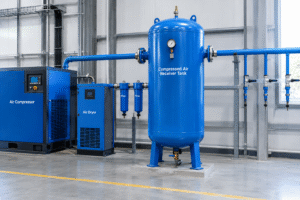
A compressed air receiver tank is a pressure-rated vessel designed to store compressed air produced by an air compressor. It acts as a buffer between compressed air generation and consumption, helping the system respond to variations in demand.
Industrial air receiver tanks are commonly used in manufacturing facilities, pneumatic automation systems, automotive service centres, fabrication workshops, and other applications that depend on compressed air.
Depending on the system design, a receiver tank may be installed near the compressor or closer to the point of use.
How Does an Air Receiver Tank Work?
The operating principle is straightforward:
Air compression: The compressor draws in atmospheric air and compresses it to the required operating pressure.
Air storage: Compressed air enters the receiver tank, where it is stored under pressure.
Demand fluctuations: When connected equipment requires additional air, the stored air helps supply the temporary increase in demand.
Pressure recovery: The compressor replenishes the stored air as the system consumes it.
Moisture management: As compressed air cools, some moisture may condense inside the receiver and must be removed through suitable condensate management equipment.
The receiver tank does not create additional compressed air or increase the compressor’s continuous production capacity. Instead, it stores air produced earlier so that it can be used when required.
Types of Compressed Air Receiver Tanks
Choosing the appropriate receiver tank depends on the compressor arrangement, air demand, available space, and application requirements.
1. Wet Air Receiver Tank
A wet receiver is installed upstream of the air dryer. It provides storage capacity and can help cool compressed air, allowing some moisture to condense before the air enters downstream treatment equipment.
This arrangement can be useful when the system requires buffering between the compressor and the dryer.
2. Dry Air Receiver Tank
A dry receiver is installed downstream of the air dryer and associated treatment equipment. It stores treated compressed air and helps accommodate fluctuations in demand at the point of use.
It is particularly useful when connected equipment needs a more stable supply of dry compressed air.
3. Combined Receiver Arrangement
Some industrial installations use both wet and dry receiver tanks. This arrangement can provide additional storage and operational flexibility, depending on compressor controls, dryer capacity, and the site’s air demand profile.
The correct configuration should be determined from the complete compressed air system design rather than tank capacity alone.
Benefits of a Compressed Air Receiver Tank
A properly selected air receiver can contribute to reliable industrial operations in several ways.
1. Helps Stabilize System Pressure
Pneumatic tools, cylinders, valves, and automated machines may consume compressed air in short bursts. A receiver tank provides stored air during these demand peaks, helping reduce rapid pressure fluctuations.
The amount of improvement depends on tank capacity, compressor output, operating pressure, and the size and duration of the demand peaks.
2. Supports Efficient Compressor Operation
In systems using load/unload or pressure-switch controls, adequate receiver capacity can reduce excessive short cycling when the tank and control settings are correctly matched to the compressor.
Reduced cycling can help support reliable operation and may reduce unnecessary starts, depending on the compressor type and control strategy.
3. Handles Temporary Increases in Air Demand
Certain production processes require more air for short periods than they consume on average. A receiver can supply part of this temporary demand while the compressor responds.
This is valuable for pneumatic machinery, intermittent blow-off applications, and production equipment with variable consumption.
4. Supports Moisture Separation
As compressed air cools, water vapour may condense. A wet receiver can provide an opportunity for some condensate to separate from the air.
However, a receiver alone does not guarantee the required compressed air quality. Appropriate aftercoolers, moisture separators, filters, dryers, and automatic drains may also be necessary.
5. Improves System Flexibility
Stored compressed air can help a system accommodate changing demand without requiring the compressor to respond instantly to every short-duration increase.
A well-designed storage arrangement can also support future equipment additions, provided the compressor, piping, treatment equipment, and total system capacity are adequate.
How to Size a Compressed Air Receiver Tank
Selecting the right receiver capacity is important for achieving dependable system performance. An undersized tank may provide insufficient buffering during peak demand, while an unnecessarily large tank can increase cost, space requirements, and stored-energy hazards.
There is no single receiver size that is suitable for every compressor. Sizing depends on air consumption, compressor output, acceptable pressure variation, and the duration of peak demand.
Factors to Consider Before Selecting Tank Capacity
1. Compressor capacity
Determine the compressor’s actual delivered airflow, commonly expressed in CFM or m³/min. Use the manufacturer’s rated performance at the intended operating pressure rather than relying only on motor horsepower.
2. Operating pressure
Identify the normal operating pressure and the minimum pressure the connected equipment can tolerate. The usable amount of stored air depends on the permitted pressure range.
3. Air demand
Calculate the total air consumption of connected equipment and identify whether demand is continuous, intermittent, or highly variable.
4. Peak demand duration
Determine how long the system must supply air above the compressor’s available output. A brief demand peak and a sustained demand increase require different storage capacities.
5. Compressor control strategy
Load/unload compressors, variable-speed compressors, and systems with multiple compressors may need different receiver-sizing approaches.
A Basic Air Receiver Sizing Formula
For an initial estimate of the receiver volume needed to supply a temporary airflow deficit, the following relationship can be used:
Receiver volume:
V = Q × t × Pₐ / (P₁ − P₂)
Where:
V = receiver volume in litres
Q = airflow deficit in litres per second, expressed as free-air delivery
t = duration of the demand peak in seconds
Pₐ = atmospheric pressure, approximately 1.013 bar absolute
P₁ = initial receiver pressure in bar absolute
P₂ = minimum acceptable receiver pressure in bar absolute
This simplified calculation assumes approximately isothermal behaviour and consistent airflow expressed as free air. It is an estimate, not a substitute for a complete engineering design.
For gauge-pressure readings, convert to absolute pressure before using the formula:
Absolute pressure = Gauge pressure + Atmospheric pressure
Worked Example: Estimating Receiver Tank Capacity
Suppose an industrial system has a temporary demand deficit of 200 litres per minute for 30 seconds. The receiver pressure is allowed to fall from 8 bar gauge to 7 bar gauge.
First, convert the airflow deficit:
200 litres/minute ÷ 60 = 3.33 litres/second
The pressure difference is 1 bar because both gauge pressures are measured relative to the same atmospheric pressure.
Using the simplified formula:
V = 3.33 × 30 × 1.013 ÷ 1
V ≈ 101 litres
This gives a theoretical receiver volume of approximately 101 litres for the specified temporary deficit under the stated assumptions.
The final selected tank may need to be larger after accounting for actual compressor response, control settings, usable pressure range, demand variability, applicable standards, and manufacturer recommendations.
Important Receiver Sizing Considerations
The example above addresses a specific temporary demand deficit. It should not be used as a universal rule for selecting a tank based solely on compressor horsepower.
For a complete design, consider:
Compressor free-air delivery at operating pressure
Measured peak and average consumption
Permissible pressure variation
Compressor response time and control method
Required reserve for critical equipment
Dryer and filter flow capacity
Applicable pressure-vessel regulations and manufacturer guidance
For complex systems or critical production applications, consult a qualified compressed air system designer.
Compressed Air Receiver Tank Installation Best Practices
Correct installation is essential for safety, accessibility, and reliable system operation.
1. Choose a Suitable Location
Install the receiver in an accessible, adequately ventilated location that allows inspection, drainage, and maintenance. Consider the floor’s load-bearing capacity and provide the clearances specified by the manufacturer and applicable regulations.
The vessel must be suitable for the intended pressure, temperature, and compressed air service.
2. Provide Appropriate Pressure Protection
A receiver tank must have suitable pressure-relief protection, pressure indication, and other safety equipment required by its design and applicable regulations.
Never isolate, obstruct, or disable a required pressure-relief device. The relief device must be correctly selected and maintained.
3. Install Effective Condensate Drainage
Condensate can accumulate inside a receiver. Provide suitable drainage equipment and establish a maintenance schedule to prevent excessive water accumulation and related problems.
Where condensate contains oil, disposal must follow applicable environmental requirements.
4. Design the Connected Piping Correctly
The piping connected to the receiver should accommodate the required airflow and operating pressure without creating excessive pressure loss.
A well-designed distribution layout, appropriately sized pipes, compatible fittings, and suitable isolation valves help support dependable compressed air delivery.
Quickair’s modular piping solutions can be considered when designing or upgrading compatible industrial compressed air distribution networks. Always confirm the pressure rating, temperature limits, materials, and fitting compatibility for the intended application.
5. Allow for Inspection and Maintenance
Keep gauges, drains, inspection points, and required safety devices accessible. Follow the vessel manufacturer’s instructions and applicable inspection requirements.
Do not weld, drill, modify, or repair a pressure vessel unless the work is specifically permitted and carried out under the applicable approved procedures.
6. Follow Applicable Safety Regulations
Compressed air receiver tanks contain stored energy and can be hazardous if incorrectly selected, installed, operated, or maintained.
Use a properly rated vessel and follow relevant local pressure-vessel regulations, inspection requirements, and manufacturer instructions. In India, applicable requirements may include the relevant provisions governing static and mobile pressure vessels, as applicable to the equipment and installation.
Common Air Receiver Tank Sizing and Installation Mistakes
Avoid these common errors when planning an industrial compressed air system.
Selecting a tank using horsepower alone: Compressor horsepower does not fully describe airflow, pressure requirements, or peak demand.
Ignoring demand fluctuations: Average air consumption may not reveal short, high-demand production cycles.
Choosing a tank without checking the pressure range: Only the permitted pressure reduction is available for buffering demand.
Neglecting condensate removal: Accumulated water can contribute to corrosion and downstream air-quality problems.
Overlooking downstream equipment capacity: A large receiver cannot compensate for an undersized compressor, dryer, filter, or distribution line during sustained demand.
Ignoring pressure-vessel compliance: A receiver must meet the requirements applicable to its location, design, service, and operating conditions.
How a Receiver Tank Works With a Modular Compressed Air Piping System
A receiver tank is only one part of a complete compressed air installation. Efficient performance also depends on suitable piping design, connection quality, air treatment, and maintenance.
A typical industrial arrangement may include:
An air compressor
An aftercooler and moisture separator, where required
A wet receiver tank, where appropriate
Air treatment equipment, such as filters and dryers
A dry receiver tank, where appropriate
A distribution network supplying production equipment
The exact sequence depends on the system design and required air quality.
Modular compressed air piping can help simplify distribution-system assembly, support future layout changes, and provide organized connections to machinery when the system is correctly designed.
Quickair provides modular piping solutions intended for industrial applications. When planning a new installation or upgrading an existing network, selecting compatible pipes, fittings, and connection components is essential for dependable performance.
Frequently Asked Questions
1. What is the main purpose of a compressed air receiver tank?
Its main purpose is to store compressed air and help balance fluctuations between compressor output and equipment demand. It can also support pressure stability and compressor control, depending on the system configuration.
2. How do I calculate the correct air receiver tank size?
Start with compressor airflow, peak air consumption, the acceptable pressure range, and the duration of peak demand. Use an appropriate sizing method and confirm the result with the compressor manufacturer’s recommendations or a qualified system designer.
3. Does a larger receiver tank reduce electricity consumption?
Not automatically. Correctly sized storage may improve control behaviour and reduce unnecessary cycling in suitable systems. Energy savings depend on compressor type, control strategy, leakage, pressure settings, and operating patterns.
4. Should an air receiver be installed before or after the air dryer?
A wet receiver is generally installed before the dryer, while a dry receiver is installed after it. Some systems use both. The best arrangement depends on demand patterns, air-quality requirements, and equipment design.
5. How often should an air receiver tank be drained?
Drainage frequency depends on humidity, compressor conditions, receiver temperature, and condensate-management equipment. Automatic drains can help manage routine condensate removal, but they still require inspection and maintenance.
6. Can an air receiver tank compensate for an undersized compressor?
It can supply stored air during short demand peaks, but it cannot continuously replace insufficient compressor capacity. If demand consistently exceeds production, the system requires a capacity assessment.
7. What maintenance does a compressed air receiver require?
Maintenance may include checking drainage equipment, gauges, pressure-relief devices, external condition, corrosion indicators, and required inspection records. Follow the manufacturer’s maintenance schedule and applicable statutory requirements.
Conclusion
A compressed air receiver tank plays an important role in balancing air demand, supporting pressure stability, and improving the operational flexibility of industrial compressed air systems. Choosing the correct capacity requires more than looking at compressor horsepower; airflow demand, pressure limits, demand duration, and control behaviour must all be considered.
Equally important are safe installation, effective condensate drainage, appropriate pressure protection, and a properly designed piping network.
Whether you are installing a new compressed air system or upgrading an existing factory network, a coordinated approach to storage, air treatment, and distribution can help support reliable industrial performance.
Planning an industrial compressed air piping system?
Explore Quickair’s modular piping solutions at https://www.quickair.in/ or contact the Quickair team to discuss your application and piping requirements.