
What Are Compressed Air Fittings?
Compressed air fittings are the connectors used to join sections of tubing, hose, and pipe within a pneumatic system. Every compressor installation, from a small portable unit to a plant-wide distribution network, relies on these connectors to keep pressurized air moving safely from the compressor to the point of use without leaking at the joints. A quality fitting maintains a tight seal under constant pressure cycling, resists vibration loosening, and stands up to the moisture and light oil mist typically present in shop air lines.
Because a fitting sits at every junction in the system — after the compressor, at the filter-regulator-lubricator (FRL) unit, along the header pipe, and at each drop leg to a tool — even a small percentage of leaky connections adds up to significant wasted energy. Industry studies often cite leaks at connection points as one of the largest sources of compressed air system losses, which is why selecting the right hardware deserves real attention rather than being treated as an afterthought.
Types of Compressed Air Fittings 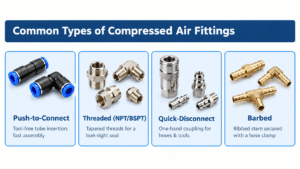
The four most common styles of compressed air fittings
- Push-to-connect: The tube is simply pushed into the body and gripped by an internal collet, making this style fast to install and easy to reconfigure without tools.
- Threaded (NPT/BSPT): These use tapered threads sealed with thread tape or sealant, and are the standard choice for permanent connections to manifolds, regulators, and rigid pipe runs.
- Quick-disconnect couplings: Designed for connecting and removing hoses or tools with one hand, these are common at the point of use where equipment changes frequently.
- Barbed: A ribbed stem is inserted into flexible hose and secured with a clamp, offering an economical option for low-pressure or temporary air lines.
How to Choose the Right Compressed Air Fittings
Selecting the right connector comes down to matching it to your system’s pressure, tubing material, and connection style. Keep the following factors in mind:
- Pressure rating: Confirm the maximum working pressure exceeds your compressor’s output, with a reasonable safety margin.
- Thread standard: Match NPT (tapered, common in North America) or BSPT/BSPP (common internationally) to your existing pipework to avoid cross-threading.
- Tubing size and material: Nylon, polyurethane, and copper tubing each require differently sized push-to-connect or compression-style hardware.
- Body material: Brass and nickel-plated brass resist corrosion and handle higher temperatures; composite or polymer bodies are lighter and resist chemical exposure.
- Environment: For washdown areas, outdoor lines, or food-grade applications, choose hardware rated for moisture, UV exposure, or sanitary standards.
Installation Best Practices for Compressed Air Fittings
Proper installation is what actually determines whether a connection stays leak-free over time. Follow these steps for reliable results:
- Cut tubing square using a proper tubing cutter — an angled or crushed cut prevents push-to-connect styles from sealing correctly.
- Apply PTFE thread tape or an anaerobic sealant to threaded connections, wrapping in the direction of the threads, and avoid overtightening, which can crack the fitting body.
- Support long tubing and hose runs so the weight doesn’t place strain directly on the connection point.
- Pressurize gradually after installation and check every joint with a soap-water solution to spot bubbles indicating a leak.
- Label or color-code lines by function (air, vacuum, or specialty gas) to prevent cross-connection during future maintenance.
Maintenance Tips to Extend the Life of Compressed Air Fittings
Routine maintenance keeps every connection performing at its best long after installation:
- Inspect fittings periodically for visible cracking, discoloration, or corrosion, especially in humid or outdoor environments.
- Re-check torque on threaded joints after the first few pressure cycles, since initial settling can slightly loosen a connection.
- Keep push-to-connect release collets free of dust and debris so the internal collet continues to grip the tubing securely.
- Drain moisture from filters and traps regularly — trapped condensate accelerates internal corrosion in metal components.
- Replace, rather than repair, any part showing thread damage or a cracked body; the cost of a new fitting is far lower than the cost of an unplanned system leak.
Frequently Asked Questions
What size fittings do I need for my air compressor?
Sizing depends on the outlet on your compressor and the inside diameter of your hose or tubing. Most home and light-shop setups use 1/4-inch NPT connections, while industrial systems often step up to 3/8-inch or 1/2-inch to reduce pressure drop over longer runs. Always match the connector’s thread and bore size to both ends of the line rather than assuming a single size fits the whole system.
Can I mix brass and plastic connectors in the same line?
Yes, as long as each part is rated for your system’s operating pressure and temperature. Many shops use brass at the compressor and manifold, where durability matters most, and switch to lightweight push-to-connect composite hardware further down the line where hoses are reconfigured often.
How often should fittings be replaced?
There’s no fixed schedule — replacement is condition-based. Inspect connections every few months, and swap out any part that shows cracking, persistent leaking after re-tightening, or thread wear. In dusty or outdoor environments, more frequent checks are worthwhile.
Final Thoughts
Compressed air fittings may be small, but they directly determine how efficient, safe, and reliable your entire pneumatic system is. Taking the time to choose the correct type, size, and material — and installing and maintaining each connection properly — pays off in fewer leaks, lower energy costs, and less unplanned downtime. Whether you’re building a new air line from scratch or upgrading an existing one, investing in quality hardware is one of the simplest ways to protect the rest of your system.