
What Are Air Pipe Fittings?
Air pipe fittings are the components used to connect, redirect, branch, or terminate sections of rigid pipe carrying compressed air. Unlike flexible hose connectors, these are typically threaded or welded onto metal or rigid plastic pipe and form the backbone of a facility’s fixed air distribution system — running from the compressor room, through the header line, and down to individual drop legs at each workstation.
Because a rigid piping network is largely permanent once installed, the quality of each joint matters enormously. A poorly sealed connection not only wastes compressed air and energy, it can also introduce moisture ingress, pressure drop, and — in older galvanized systems — internal corrosion that gradually restricts flow. Selecting the correct fitting for each junction, and installing it correctly, is one of the most cost-effective ways to protect the performance of the whole system.
Types of Air Pipe Fittings 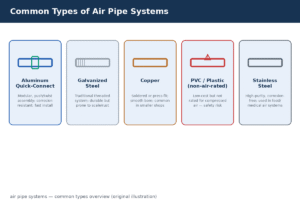
A typical compressed air network uses several distinct shapes to route pipe around a building and to different points of use. The most common styles are shown below.
Figure 2: Five fitting shapes found in most rigid air piping systems
- Elbow: Turns the line 45 or 90 degrees, letting pipe run around corners, columns, or ceiling obstructions.
- Tee: Splits a single line into a branch, commonly used to drop a line down to a workstation or tool station.
- Coupling: A straight connector that joins two lengths of pipe of the same diameter in a continuous run.
- Union: Similar to a coupling but designed to be disassembled without cutting the pipe, useful anywhere future maintenance is expected.
- Reducer: Steps a line down from a larger header diameter to a smaller branch diameter as flow requirements decrease.
How to Choose the Right Air Pipe Fittings
Choosing correctly means balancing material, thread standard, and the layout of your piping run. Consider the following before ordering parts:
- Pipe material: Match galvanized steel, black steel, copper, or aluminum piping to fittings made from a compatible material to avoid galvanic corrosion at the joint.
- Thread standard: NPT (tapered) is standard in North America, while BSPT and BSPP are common elsewhere — mixing standards causes leaks even when a fitting appears to thread on.
- Pressure and diameter: Confirm the pressure rating and bore size are adequate for the branch or header they’re installed on, especially at reducers and tees feeding multiple tools.
- Layout needs: Favor unions at any point that may need future disassembly, and minimize unnecessary elbows, since each turn adds a small amount of pressure drop.
- Certification: For food-grade, medical, or high-purity air systems, confirm the fitting meets the relevant industry certification before installation.
Installation Best Practices for Air Pipe Fittings
How a joint is installed has as much impact on leak resistance as the part itself. Keep these practices in mind on every run:
- Ream and deburr cut pipe ends before threading or gluing, since burrs create tiny leak paths at the joint.
- Apply the correct sealant for the material — PTFE tape or pipe dope for threaded metal connections — and avoid overtightening, which can crack fitting bodies.
- Slope horizontal header runs slightly toward drain points so condensate flows away from equipment instead of pooling at low spots.
- Support pipe runs at regular intervals so the weight of the line doesn’t place ongoing stress on any single joint.
- Pressure test the completed system before putting it into service, checking every connection with a soap solution or a dedicated leak detector.
Maintaining Air Pipe Fittings Over Time
A rigid piping system needs far less day-to-day attention than flexible hose lines, but periodic checks still matter:
- Walk the header line periodically listening and looking for hissing air, frost, or oil staining around joints, which often signal a developing leak.
- Check unions and couplings after any nearby vibration source (new equipment, compressor changes) is installed, since vibration can loosen a previously sound joint.
- Drain low-point condensate traps regularly to limit internal corrosion, particularly in older galvanized steel networks.
- Re-torque or reseal any joint that develops a slow leak rather than letting it persist — small leaks compound quickly across a large facility.
- Keep a small stock of common sizes and shapes on hand so a failed fitting can be swapped quickly instead of causing extended downtime.
Frequently Asked Questions
What’s the difference between a coupling and a union?
A coupling makes a fixed, permanent joint between two pipe ends and generally cannot be removed without cutting the pipe. A union includes a separable center nut, allowing the joint to be disconnected for repairs or equipment changes without disturbing the surrounding pipe run.
Can I mix metal and plastic parts in the same air line?
It depends on the products involved and your system’s pressure and temperature. Some plastic-to-metal adapters are rated for compressed air service, but always check manufacturer compatibility and pressure ratings first, since mismatched materials can fail at the joint or create galvanic corrosion over time.
How do I know if my piping network has a leak?
A sustained drop in system pressure when tools are idle, an compressor that cycles more often than expected, or audible hissing near joints are all common signs. A soap-solution test or an ultrasonic leak detector will pinpoint the exact location once you suspect a leak is present.
Final Thoughts
Air pipe fittings are the connective tissue of any rigid compressed air system, and their condition has an outsized effect on efficiency, safety, and uptime. Taking the time to select the correct material, thread standard, and shape for each junction — and installing every joint carefully — keeps pressure loss and maintenance costs to a minimum. Whether you’re laying out a brand-new distribution line or repairing an aging network, treating each connection as a critical component rather than an afterthought pays off for the life of the system.