Quickair
Quickair
Corrosion is one of the most expensive problems in industrial piping — and one of the easiest to prevent with the right material choice from the start. If you’re specifying or upgrading a compressed air system, understanding what makes corrosion resistant piping worth the investment can save years of maintenance headaches and protect the quality of the air reaching your equipment.
Compressed air always carries some moisture, even after drying — condensation forms inside pipework as air cools while moving through the system. In traditional galvanized steel or black iron pipe, that moisture attacks the pipe’s interior over time, even though the outer galvanized coating looks intact. The result is internal rust and scaling that most facilities don’t notice until it starts affecting downstream equipment.
Once corrosion starts, it doesn’t stay contained. Rust particles break loose and travel through the airstream into valves, regulators, pneumatic tools, and — in sensitive environments — directly into the product or process.
Contaminated air quality. For food, pharmaceutical, and electronics manufacturing, particulate contamination from a corroding pipe can mean failed quality checks or damaged sensitive components.
Increased maintenance. Valves and regulators wear out faster when rust particles pass through them repeatedly. What should be a low-maintenance system turns into a recurring repair line item.
Reduced airflow over time. Internal scaling narrows the effective pipe diameter, increasing pressure drop and forcing your compressor to work harder for the same output.
Eventual pipe replacement. Corrosion is progressive — a system that starts corroding will eventually need sections replaced, at a cost far higher than choosing corrosion resistant piping from the outset.
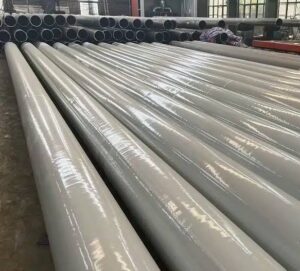
An aluminum piping system doesn’t rust the way steel does. Its natural oxide layer protects against corrosion, and it stays smooth-bore for the system’s service life, which also means airflow and pressure performance don’t degrade over time the way they do in aging steel pipework. This is a major reason aluminum has become the standard choice for new compressed air installations.
Stainless steel offers excellent corrosion resistance and is often specified for pharmaceutical or high-purity applications where material standards require it. It typically costs more than aluminum and, unlike modular aluminum systems, often still requires welding — meaning longer installation time.
PEX resists corrosion by nature (it’s a polymer, not metal), and is sometimes used for lower-pressure compressed air or vacuum applications. It’s not a substitute for metal piping in higher-pressure industrial air distribution, but has a place in specific use cases.
Standard galvanized steel and black iron remain common simply because they’re familiar and cheaper upfront — but for any new corrosion resistant piping decision, they’re the baseline being replaced, not the benchmark to match.
For guidance on getting pipe diameter right alongside your material choice, see our compressed air pipe sizing guide. If you’re still deciding between aluminum and steel more broadly, our aluminium vs steel compressed air pipe comparison breaks down the full cost picture.
It’s worth noting that corrosion resistant piping isn’t just a durability decision — it’s an efficiency one. According to the U.S. Department of Energy’s compressed air systems guidance, maintaining consistent pipe diameter and minimizing leaks are among the most effective ways to reduce compressed air energy costs, and corrosion directly undermines both over time.
Choosing corrosion resistant piping at the design stage is significantly cheaper than dealing with a corroding system later — both in direct maintenance costs and in the air quality risks that come with it. For most industrial applications, an aluminum piping system delivers the best combination of corrosion resistance, installation speed, and long-term cost.
Not sure which material fits your specific application? Talk to a QuickAir engineer for a free material and system consultation.
Welcome Back 👋
Sign in to access your account and continue where you left off.
Welcome aboard 🚀
Create your account to access everything you need.
Links
Contact Us